

Meghalaya to Witness Grand Lunar Spectacle Tonight as Total Lunar Eclipse совпides with Holi.
A rare total lunar eclipse (Chandra Grahan) will be visible over Meghalaya this evening, offering residents a prime view of the “Blood Moon” phenomenon under clear eastern skies. The event coincides with the Holi festival, making it a unique cultural-astronomical moment that has captured public imagination.
 News Daily
 Shillong, March 3, 2026:
Residents across Meghalaya are gearing up for a rare celestial event this evening as a total lunar eclipse, popularly known as Chandra Grahan, becomes visible across the northeastern skies. The astronomical phenomenon — often referred to as a “Blood Moon” — is expected to unfold under largely clear conditions, offering skywatchers a dramatic and uninterrupted view.
Adding to the uniqueness of the occasion, the eclipse coincides with the festival of Holi, creating a rare convergence of science and celebration that has captured public attention across the state.
What Will Happen Tonight?
A total lunar eclipse occurs when the Earth passes directly between the Sun and the Moon, casting a shadow that gradually engulfs the lunar surface. Unlike a solar eclipse, which requires protective eyewear, a lunar eclipse is completely safe to observe with the naked eye.
As the eclipse progresses through its phases — penumbral, partial and total — the Moon will slowly darken before taking on a reddish or copper hue during totality. This striking color is caused by Earth’s atmosphere bending sunlight and filtering out shorter blue wavelengths, allowing red light to illuminate the Moon.
Astronomical observers indicate that the total phase will last for over an hour, providing ample time for residents to witness and photograph the phenomenon.
Ideal Viewing Conditions in Meghalaya
Meteorological forecasts suggest partly clear skies across East Khasi Hills, Ri-Bhoi and parts of West Jaintia Hills. Shillong, known for its elevated terrain and relatively lower light pollution in surrounding outskirts, is expected to provide favorable vantage points.
Local astronomy enthusiasts and student groups have organized informal observation sessions in select areas. Educational institutions are also encouraging students to witness the eclipse as a practical science-learning opportunity.
Experts recommend choosing open spaces away from bright artificial lighting to enjoy the best view.
Science Behind the “Blood Moon”
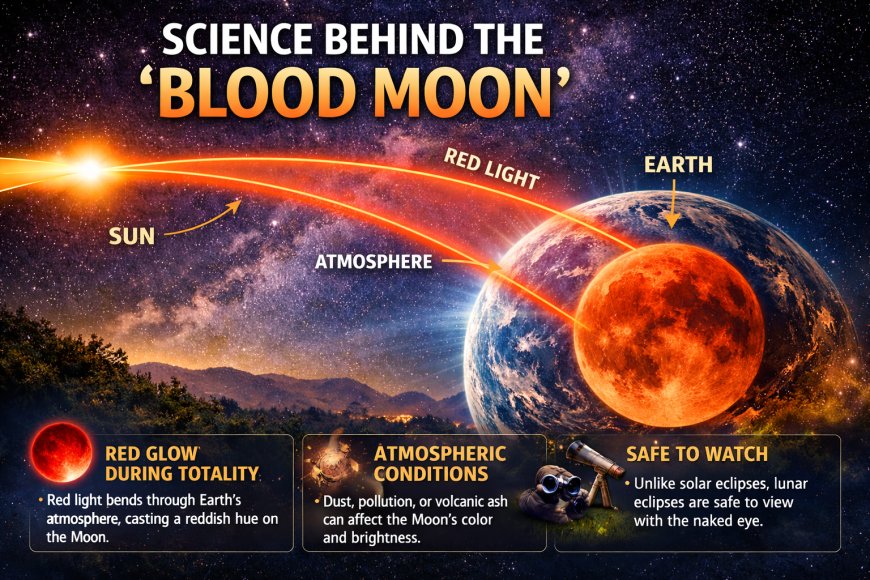
During totality, the Moon does not disappear. Instead, it glows red due to a process similar to what causes sunsets to appear crimson. As sunlight passes through Earth’s atmosphere, shorter wavelengths scatter while longer red wavelengths bend around the planet and fall onto the Moon’s surface.
Scientists note that the brightness and shade of red can vary depending on atmospheric conditions such as dust, pollution or volcanic particles. Clearer skies typically produce a brighter copper-red Moon.
Unlike solar eclipses, lunar eclipses pose no risk to eyesight and require no special equipment — though binoculars or telescopes can enhance the experience.
Cultural Significance and Holi Connection
The overlap with Holi adds cultural depth to the evening’s spectacle. Holi, symbolizing renewal, unity and the triumph of good over evil, is traditionally celebrated with colors, music and community gatherings.
In several parts of India, lunar eclipses carry religious interpretations, often linked to mythological narratives involving celestial forces. While such beliefs remain part of cultural heritage, scientists emphasize that eclipses are predictable astronomical events governed by orbital mechanics.
In Meghalaya’s multicultural society, the combination of a vibrant daytime festival and a dramatic nighttime celestial event has created widespread excitement.
Public Awareness and Myth-Busting
Authorities and educators have reiterated that lunar eclipses are natural phenomena with no harmful effects. Unlike solar eclipses, there is no radiation risk involved.
Health officials have clarified that food, water and daily activities remain unaffected. Pregnant women, children and the elderly face no scientific risk from viewing the eclipse.
Science clubs and academic institutions are using the occasion to promote evidence-based understanding and encourage curiosity about astronomy.
Security and Crowd Management
Shillong Police have stated that regular patrols will be maintained in popular public areas such as Shillong Peak and Ward’s Lake to ensure safety during evening gatherings.
While no large-scale crowds are anticipated, authorities have advised citizens to exercise caution when visiting elevated viewpoints and to avoid congested roads.
There are no power or communication disruptions expected as a result of the eclipse.
Tourism and Social Media Buzz
Local tourism stakeholders believe the event could draw short-term visitors, particularly photography enthusiasts hoping to capture the Moon against Meghalaya’s scenic hills.
Social media platforms are already witnessing increased activity with hashtags related to the Blood Moon and Chandra Grahan. Amateur photographers and content creators are preparing time-lapse setups to document the eclipse’s phases.
Rural areas with lower light pollution may offer particularly striking visuals for astrophotography.
A Shared Moment Under the Night Sky
Astronomers describe lunar eclipses as among the most accessible cosmic events — visible without equipment and viewable simultaneously by millions across continents.
For Meghalaya, tonight’s eclipse represents more than a scientific occurrence. It is a reminder of Earth’s place within the larger cosmic system — a silent celestial alignment unfolding above the hills.
As Holi festivities wind down and the sky darkens, residents are encouraged to step outside, look up and witness a rare astronomical performance that blends science, culture and natural beauty.
With clear skies forecast and excitement building, Meghalaya’s night promises to be illuminated not just by celebration — but by a glowing red Moon suspended in the heavens.