
Farmers in Ri-Bhoi and West Khasi Hills Demand MSP Support for Areca Nut and Ginger.
The demand for better MSP support for areca nut and ginger farmers in Ri-Bhoi and West Khasi Hills reflects deeper concerns about agricultural sustainability in Meghalaya.
 Publishers
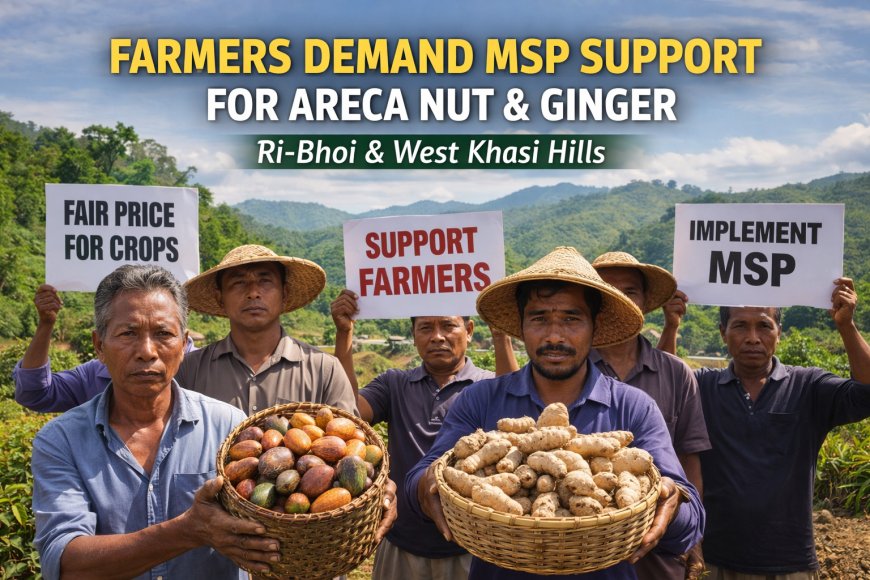
Shillong, February 26, 2026: Farmer groups in Ri-Bhoi and West Khasi Hills have formally demanded government intervention to address falling returns from areca nut and ginger cultivation, two of Meghalaya’s key cash crops. Delegations submitted memorandums to district authorities this week, urging the state to introduce Minimum Support Price (MSP) coverage or alternative price stabilization measures.
The farmers say sharp price fluctuations, rising input costs, and limited procurement mechanisms have made cultivation increasingly uncertain, threatening rural livelihoods across both districts.
Price Volatility Sparks Concern
Areca nut and ginger form a significant portion of household income for small and marginal farmers in the two districts. However, growers report that farm-gate prices have declined in recent months due to supply gluts, fluctuating interstate demand, and the absence of a structured government procurement system.
In Ri-Bhoi, farmers claim that middlemen dominate the market chain, often dictating prices without transparent benchmarks. Ginger cultivators in West Khasi Hills have echoed similar concerns, pointing to post-harvest distress sales during peak production periods.
“We invest months of labor and resources, but the returns do not reflect our effort,” said a farmer representative during a memorandum submission in Nongpoh.
Lack of MSP Coverage
Unlike staple crops such as paddy and wheat, areca nut and ginger do not currently benefit from MSP-backed procurement in Meghalaya. Farmers argue that without a guaranteed minimum price, they remain exposed to volatile market conditions.
They have urged the state government to either push for inclusion of these crops under the MSP framework or implement a state-level price intervention scheme.
Agricultural experts note that MSP for horticultural crops presents logistical challenges, including storage requirements and procurement infrastructure. However, farmers insist that some form of price floor or compensation mechanism is necessary to ensure income stability.
Rising Costs Add to Pressure
Growers also highlighted increasing input expenses, including fertilizers, pest control measures, and transportation costs. In interior villages of West Khasi Hills, poor road connectivity in certain stretches continues to add to logistical burdens, especially during the monsoon season.
Ginger farmers face additional challenges due to limited storage facilities, forcing them to sell produce immediately after harvest when market prices are often at their lowest. Without cold storage or processing units, value addition remains minimal.
Areca nut farmers, many of whom have long-term plantations, say price drops undermine the viability of investments made years ago.
Agriculture’s Role in Rural Economy
Agriculture remains a primary source of livelihood in Meghalaya’s rural areas. In Ri-Bhoi and West Khasi Hills, a large percentage of households depend directly or indirectly on farming activities.
Areca nut cultivation is deeply embedded in local cultural practices and maintains consistent demand across Northeast India. Ginger from Meghalaya is valued for its quality and is supplied to markets in Assam and other states.
Any sustained decline in returns, farmers warn, could lead to economic instability, increased rural debt, and youth migration.
Memorandums Submitted to Authorities
Farmer associations in both districts have called for:
- Introduction of MSP or price stabilization schemes
- Creation of government procurement centers
- Development of cold storage and processing facilities
- Strengthening of Farmer Producer Organizations (FPOs)
- Improved transport and market linkages
District officials have acknowledged receipt of the memorandums and assured that the concerns will be forwarded to higher authorities for consideration.
Government’s Likely Response
While there has been no immediate announcement, officials indicated that options such as Market Intervention Schemes (MIS) and cooperative marketing models may be explored.
Policy experts suggest that direct MSP procurement for perishable horticultural crops can be complex. However, state-level price deficiency payments or aggregation through FPOs could provide alternative solutions.
The government has previously emphasized horticulture promotion and organic branding initiatives. Farmers now seek corresponding pricing safeguards to complement production support.
Political and Social Implications
The demand for MSP support comes at a time when rural economic issues are gaining prominence in public discourse. Agricultural pricing often becomes a sensitive political subject, particularly in predominantly rural districts.
Farmer leaders maintain that their protest is non-political and focused solely on economic survival. However, observers note that timely government intervention could shape rural sentiment in the months ahead.
Call for Long-Term Reform
Agricultural economists argue that beyond MSP, Meghalaya needs structural reforms to strengthen horticultural value chains. These include:
- Establishing processing hubs for ginger products
- Enhancing direct market access through digital platforms
- Improving storage and grading facilities
- Promoting cooperative export initiatives
Diversification and value addition, they say, could reduce dependence on volatile raw produce markets.