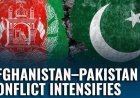

Pakistan–Afghanistan Conflict Erupts Into Open War, Triggering Regional Alarm.
The escalation between Pakistan and Afghanistan marks a dangerous chapter in South Asian geopolitics — one where local grievances, militant threats, and great‑power interests converge. With both sides entrenched in hostile postures and international calls for restraint offering limited traction, the coming weeks will be crucial in determining whether this confrontation expands further or can be contained through renewed diplomacy.
 GlobalProspects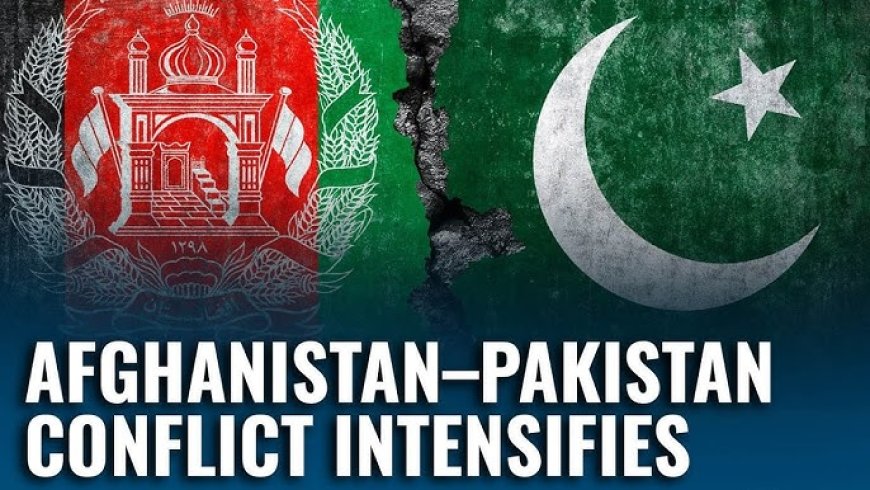
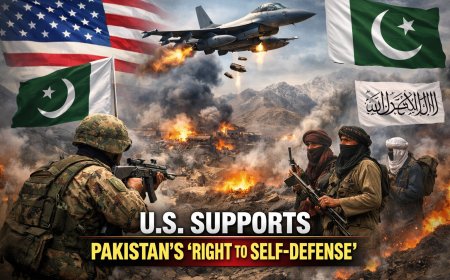
South Asia stands on the brink of a dangerous new phase of instability after Pakistan and Afghanistan descended into what officials in Islamabad have termed “open war,” following a series of large-scale cross-border airstrikes and retaliatory ground offensives. The rapid escalation marks one of the most serious confrontations between the two neighbours in decades and threatens to redraw regional security calculations across the subcontinent.
The crisis intensified late this week when Pakistani fighter jets struck targets in Afghanistan, including sites in Kabul, claiming to have hit militant infrastructure linked to the Tehreek-e-Taliban Pakistan (TTP). Kabul’s Taliban authorities responded with cross-border shelling and claimed advances along contested sections of the Durand Line, the long-disputed frontier dividing the two countries.
Islamabad described the operations as “precision counter-terror strikes” aimed at dismantling insurgent safe havens. Afghan officials, however, condemned the action as a violation of sovereignty and accused Pakistan of targeting civilian areas, escalating tensions to unprecedented levels since the Taliban returned to power in 2021.
From Fragile Truce to Full Confrontation
For months, sporadic skirmishes had plagued the mountainous borderlands. Pakistan repeatedly accused the Afghan Taliban government of failing to rein in the TTP, which has carried out a surge of attacks inside Pakistan, particularly in Khyber Pakhtunkhwa and Balochistan provinces.
The situation deteriorated sharply after several high-profile attacks on Pakistani security convoys earlier this month. Pakistani intelligence agencies alleged that TTP commanders were operating from eastern Afghan provinces with tacit tolerance from Taliban authorities. Diplomatic channels reportedly attempted back-channel negotiations, but those efforts collapsed as mutual accusations hardened.
The airstrikes on Kabul and other cities marked a turning point. Rarely in modern history has Pakistan conducted such deep strikes into Afghan territory, underscoring the gravity of Islamabad’s security concerns. Afghan forces responded by mobilizing reinforcements along the border, while Taliban spokespersons vowed to defend their territory “by all means necessary.”
The Durand Line Dispute Reignites
At the heart of the crisis lies the century-old Durand Line dispute. Drawn during British colonial rule in 1893, the boundary has never been formally recognized by successive Afghan governments. The Taliban administration has continued to reject fencing efforts by Pakistan, leading to repeated flare-ups over the past five years.
Analysts note that the border cuts through Pashtun tribal areas with deep cross-border ties. The porous terrain makes militant infiltration difficult to control and fuels Islamabad’s claims that insurgents can operate with relative ease from Afghan soil.
This longstanding disagreement has now morphed into a broader military confrontation, raising fears that entrenched grievances may prevent swift de-escalation.
Militant Networks and Security Calculus
The role of the TTP remains central to the crisis. The group, ideologically aligned but operationally distinct from the Afghan Taliban, seeks to overthrow the Pakistani state and establish a strict Islamist order. Despite past mediation attempts, violence attributed to the TTP has intensified over the past year.
Pakistan insists that it has provided Kabul with actionable intelligence on TTP hideouts. Afghan officials counter that Islamabad is using militant threats as a pretext for aggressive action. The mutual distrust has widened dramatically, transforming what was once a covert security dispute into open hostilities.
Security experts warn that prolonged fighting could create space for other extremist factions, including the Islamic State Khorasan Province (ISKP), to exploit the chaos. The spectre of a multi-actor conflict complicates counter-terrorism efforts across South and Central Asia.
Humanitarian Fears Mount
Beyond the strategic rhetoric lies a growing humanitarian concern. Reports from Kabul indicate civilian casualties and widespread panic following the strikes. Hospitals in parts of eastern Afghanistan have reportedly treated victims of shrapnel injuries, while thousands of residents fled border districts amid artillery exchanges.
Aid agencies caution that Afghanistan remains economically fragile and heavily dependent on humanitarian assistance. Any sustained military campaign risks disrupting supply chains, worsening food insecurity, and triggering fresh displacement. Pakistan, already hosting large numbers of Afghan refugees, could face renewed migration flows if the conflict deepens.
International Reactions: Calls for Restraint
Global powers have reacted with alarm. The United States acknowledged Pakistan’s security concerns but urged restraint to avoid a broader regional conflagration. Russia and Iran called for immediate dialogue and offered mediation support, highlighting fears that instability could spill into Central Asia.
China, a key economic partner of Pakistan and investor in regional connectivity projects, has reportedly sought assurances that its infrastructure corridors will not be disrupted. The escalating conflict threatens trade routes envisioned under the China–Pakistan Economic Corridor (CPEC), potentially undermining economic ambitions across the region.
The United Nations issued a statement emphasizing the protection of civilians and the need for urgent diplomatic engagement.
Implications for India and Northeast India
From an Indian strategic perspective, the escalation adds complexity to an already sensitive regional environment. New Delhi has historically maintained cautious engagement with Afghanistan while navigating adversarial ties with Pakistan. A prolonged conflict could reshape security alignments and alter the geopolitical balance in South Asia.
For Northeast India, the implications are indirect yet significant. Increased instability in the broader region may influence India’s border management strategies, intelligence coordination, and refugee preparedness. Analysts note that any shift in militant networks or transnational flows must be closely monitored, especially as India strengthens connectivity initiatives linking its northeastern states to Southeast Asia.
Furthermore, regional instability could affect energy transit projects and trade corridors connecting India to Central Asia through Afghanistan. The broader geopolitical ripple effects may reverberate across South Asia’s economic and security frameworks.
Diplomatic Prospects: Narrow but Not Closed
Despite fiery rhetoric from both sides, observers believe that space for diplomacy remains. Historically, third-party mediation—often involving Gulf states or regional powers—has helped prevent prolonged warfare between the two neighbours.
However, domestic political pressures in both Islamabad and Kabul may constrain leaders’ willingness to compromise. In Pakistan, rising public anger over militant attacks has strengthened calls for decisive military action. In Afghanistan, the Taliban leadership must balance internal cohesion with the optics of resisting foreign strikes.
Experts suggest that a temporary ceasefire could emerge if international mediation gains traction. Without it, the risk of further escalation—including deeper air campaigns or broader ground offensives—remains high.
A Region at a Crossroads
The Pakistan–Afghanistan confrontation underscores how unresolved historical disputes, militant insurgencies, and fragile state relations can rapidly spiral into open conflict. While neither side appears to seek prolonged war, the combination of mistrust and retaliatory momentum has created a volatile situation.
For South Asia, the stakes extend beyond the immediate battlefield. Economic corridors, counter-terrorism coordination, refugee management, and great-power rivalries are all entwined in this unfolding crisis.
As global actors push for de-escalation, the coming days will determine whether diplomacy can regain ground—or whether this latest flare-up becomes a defining security crisis for the region in 2026.