

Railway Expansion Accelerated in Northeast Under Act East Policy.
Border Connectivity, Economic Growth, and Strategic Priorities Drive Fast-Track Projects.
 News Daily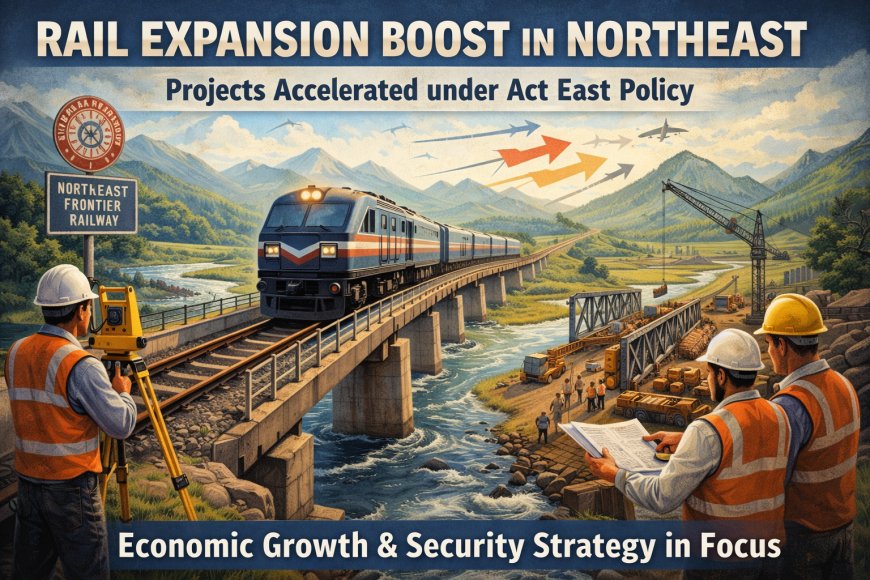
Guwahati, February 27, 2026:
Railway infrastructure development across Northeast India has entered an accelerated phase, with the Northeast Frontier Railway (NFR) confirming faster execution of key connectivity projects linking remote and border districts. Officials state that the renewed push aligns with the Government of India’s Act East Policy and reflects a broader national strategy focused on economic integration and security preparedness.
Senior railway authorities indicated that multiple pending projects across the region are being closely monitored to ensure timely completion, with enhanced budget allocations and engineering deployment aimed at overcoming terrain-related challenges.
Strategic Connectivity a National Priority
Northeast India shares international borders with China, Myanmar, Bangladesh, Bhutan, and Nepal, making infrastructure development in the region strategically significant. Improved railway access is expected to strengthen logistical mobility, support defense readiness, and reduce the isolation of remote districts.
Officials within Indian Railways described Northeast connectivity as “critical for national integration and long-term regional stability.”
Rail expansion also reduces overdependence on the Siliguri Corridor — the narrow land strip connecting mainland India to the Northeast — thereby enhancing supply chain resilience.
Major Projects Under Fast-Track Monitoring
Jiribam–Imphal Rail Line (Manipur)
One of the most ambitious projects currently underway is the Jiribam–Imphal railway line in Manipur. Once operational, it will connect the state capital to the national rail grid for the first time.
The line involves complex engineering work, including multiple long tunnels and high bridges across mountainous terrain. Railway sources confirm that construction activity has intensified, with key structural milestones nearing completion.
Sivok–Rangpo Line (Sikkim)
The Sivok–Rangpo railway project is expected to provide the first direct rail link to Sikkim. The project carries both economic and strategic value due to Sikkim’s proximity to international borders.
Given the fragile Himalayan geology, tunneling work is being executed with advanced monitoring systems and environmental safeguards.
Bairabi–Sairang Project (Mizoram)
The Bairabi–Sairang line aims to extend railway connectivity deeper into Mizoram, improving access to Aizawl and surrounding districts.
Railway engineers report steady progress, despite challenges posed by steep gradients and heavy rainfall zones.
Agartala–Akhaura Cross-Border Link
The Agartala–Akhaura rail link will strengthen connectivity between Tripura and Bangladesh, opening new trade routes and reducing travel distance to major ports.
Officials say this project will significantly boost cross-border commerce and logistical efficiency once operational.
Capacity Expansion in Assam
Within Assam, track doubling and electrification works are progressing along key corridors connecting Guwahati, Dibrugarh, Silchar, and other commercial hubs.
Electrification is expected to lower operational costs, improve speed, and reduce carbon emissions, while doubling projects will enhance freight handling capacity.
Economic Implications
Improved rail connectivity is expected to deliver multi-sectoral benefits:
Agriculture: Faster transportation of tea, spices, horticulture produce, and food grains to national markets.
Industry: Lower logistics costs for oil, natural gas, and small-scale manufacturing units.
Tourism: Easier access to scenic destinations across hill states.
Employment: Increased job creation during construction and post-completion operations.
Industry observers believe infrastructure upgrades could attract new investments in warehousing, food processing, and logistics services.
National Security Dimensions
Security analysts note that railway expansion in border states strengthens rapid deployment capabilities and enhances supply chain support for defense establishments.
Enhanced connectivity reduces response time during emergencies, including natural disasters, which are frequent in the region due to floods, landslides, and seismic activity.
Infrastructure strengthening also aligns with India’s broader strategic positioning under the Act East framework.
Engineering and Environmental Challenges
Railway development in the Northeast involves some of the most complex terrain in India. Projects require extensive tunneling through hills, bridge construction across deep valleys, and slope stabilization in landslide-prone zones.
Environmental groups have called for strict adherence to ecological norms, particularly in biodiversity-sensitive areas. Railway officials maintain that projects comply with environmental impact assessments and include mitigation measures such as reforestation and slope protection systems.
Budgetary Support and Monitoring
The Union government has increased capital expenditure for railway infrastructure in Northeast India in recent budget cycles. Officials state that the funding boost is intended to eliminate delays caused by financial constraints.
Project monitoring has also intensified, with periodic reviews at both zonal and central levels to ensure timelines are maintained.
Public Response
Residents in remote districts have largely welcomed the acceleration of railway works, viewing connectivity as a long-awaited development milestone. Community leaders say improved rail access will enhance access to healthcare, education, and employment opportunities.
However, some civil society groups urge balanced development that prioritizes environmental sustainability alongside economic growth.
The Road Ahead
With multiple projects entering advanced construction stages, 2026 is shaping up to be a significant year for railway expansion in Northeast India. The focus remains on timely execution, safety compliance, and strategic alignment with national priorities.
Officials emphasize that improved rail connectivity is not merely a transportation upgrade but a transformative step toward regional integration and long-term stability.
As the Act East Policy continues to guide infrastructure investments, the Northeast is poised to become more closely linked with mainland India and international trade corridors — reinforcing both economic opportunity and national security.