

Tripura Sets Up New Industrial Cluster to Supercharge MSME Growth.
Tripura’s industrial cluster initiative represents a strategic leap toward harnessing the untapped potential of MSMEs. By combining government incentives, financial backing, incubation support, and private sector partnerships, the state is laying the groundwork for sustained economic growth.
 News Daily
 1. Tripura Government Sets Up New Industrial Cluster to Supercharge MSME Growth.
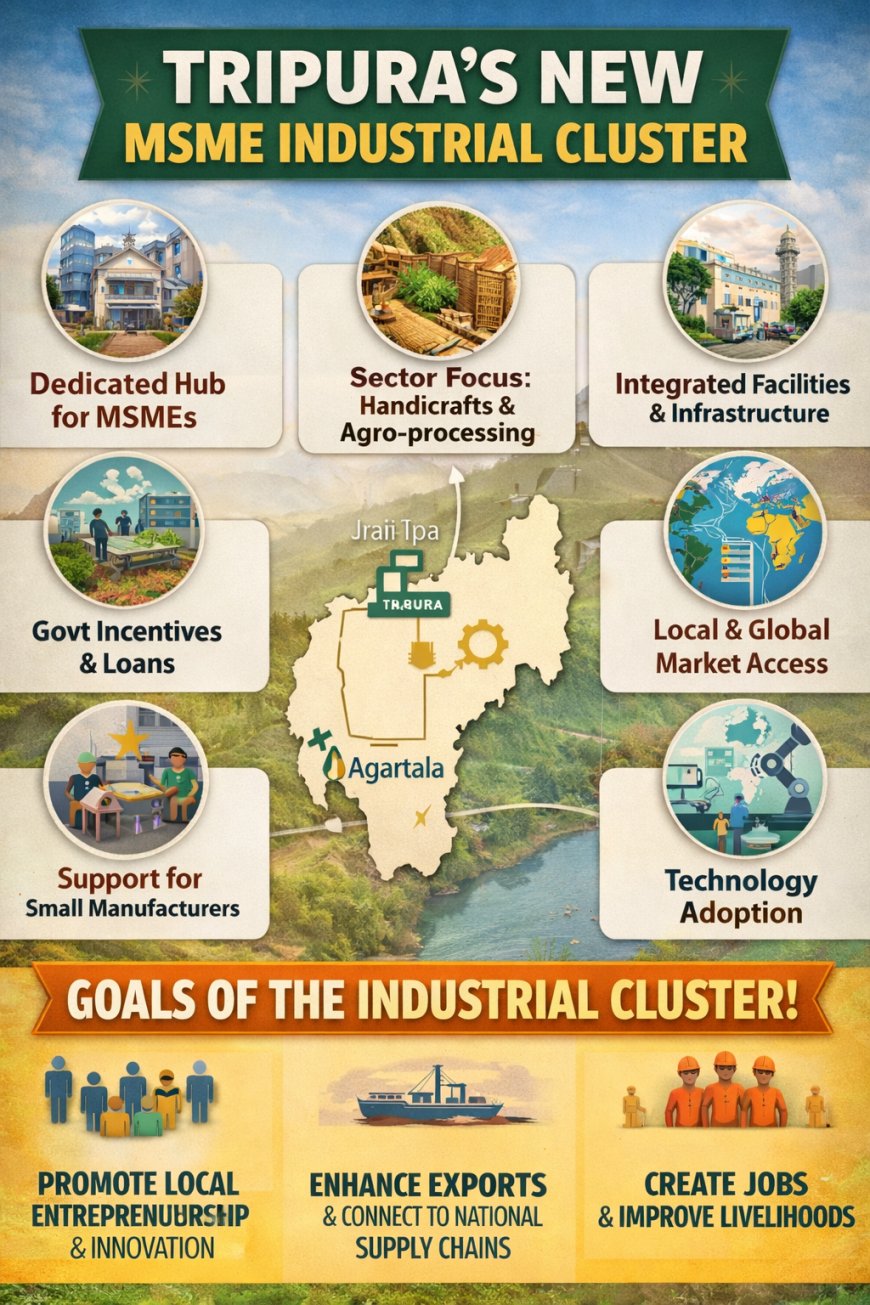
Agartala, Tripura — In a bold move to transform its economic landscape and uplift local entrepreneurship, the Government of Tripura has unveiled plans to develop a new industrial cluster aimed at supporting Micro, Small, and Medium Enterprises (MSMEs) across the state. This initiative, backed by policy reforms, innovation hubs, strategic partnerships and financial inclusion schemes, is expected to position Tripura as a rising industrial and entrepreneurial hub in Northeast India. The initiative reflects a concerted effort to strengthen Tripura’s economy by creating jobs, attracting investment, and linking local enterprise directly to larger markets, both nationally and internationally.
2. A Strategic Vision for MSMEs
Tripura’s MSME sector — encompassing traditional industries like bamboo and rubber processing to modern tech startups — is seen as a backbone of the state’s economy. According to recent government reports, the state hosts over 86,000 registered MSMEs while self-help groups (SHGs) and thousands of small enterprises contribute significantly to rural employment and household incomes.
However, growing industrial activity has historically faced challenges related to infrastructure, logistical bottlenecks, and limited access to capital. To unlock this potential, the Tripura government’s industrial cluster initiative aims to create integrated ecosystems that combine shared industrial facilities, incubation support, and direct market links, enabling small producers to scale operations efficiently.
At the heart of this strategy is the inauguration of “T-Nest” — Tripura’s first incubation and innovation hub — located in Hapania, Agartala. The facility, launched recently under the Tripura State Innovation Mission, will act as a one-stop ecosystem supporting startups and MSMEs with mentorship, access to finance, and partnerships with investors and academic institutions.
3. Tripura Innovation Drive: T-Nest and Beyond.
T-Nest — short for Tripura: Nurturing Entrepreneurship and Startups — represents a major leap in institutionalizing entrepreneurship in the state. Envisioned as part of the Atal Innovation Mission (AIM 2.0) framework, the hub aims to connect budding entrepreneurs with the resources necessary to grow scalable and sustainable enterprises.
According to officials, T-Nest will serve multiple functions:
- Incubation and Acceleration: Supporting startups with infrastructure, mentoring, and seed funding.
- Industry Partnerships: Collaborating with national incubators like T-Hub to bring structured support systems to Tripura’s entrepreneurial ecosystem.
- Sector Focus: Prioritizing sectors such as agri-technology, bamboo and forest product innovations, health tech, digital public services, and rural enterprise solutions.
- Government as First Customer: Through pilot projects addressing real public sector challenges, the model integrates innovation directly into state governance and service delivery.
Chief Minister Dr. Manik Saha has emphasized that T-Nest — combined with broader policy frameworks — will be pivotal in shifting Tripura from a resource-based economy to a knowledge and enterprise driven future. The hub aligns with a growing trend of innovation ecosystems emerging outside India’s major metropolitan centres, reinforcing Tripura’s rising status within the national startup map.
4. Government Incentives and Financial Support.
Supporting MSMEs requires not just infrastructure but also financial inclusion and incentive programs. Early this year, Tripura introduced multiple incentive schemes under its RAMP (Rural and Micro-enterprise Promotion) strategy to strengthen MSMEs, with a focus on access to credit, subsidies, and technology adoption.
Complementing state efforts, financial institutions are also playing an active role. For instance, the National Bank for Agriculture and Rural Development (NABARD) projected a significant credit potential of Rs 14,034 crore for Tripura’s priority sectors for the financial year 2026–27, signaling stronger institutional backing for business expansion across agriculture, rural industries, and allied sectors.
These developments coincide with broader national reforms to modernize India’s MSME ecosystem — including upgrades to the National Small Industries Corporation (NSIC) to Schedule ‘A’ CPSU status, which enhances its ability to support MSMEs with training, marketing, and finance.
5. Industrial Partnerships and Value Chains.
A comprehensive industrial cluster strategy also involves linking local MSMEs to larger value chains. In a significant associated development, Hindustan Zinc Limited signed a memorandum of understanding with a Tripura business group to establish a manufacturing unit within India’s first integrated downstream Zinc Industrial Park in Rajasthan.
While this hub is located outside Tripura, the partnership reflects a broader trend of tripartite collaborations between major industry players, state enterprises, and local entrepreneurs. Through assured raw material linkage and long-term offtake arrangements, these partnerships aim to provide market stability for MSME manufacturers and encourage technology adoption and investment.
6. Economic and Employment Impact
The economic impact of such industrial cluster initiatives could be transformative for Tripura. By creating shared infrastructure — from common manufacturing facilities to logistics support networks — the cluster model significantly reduces entry barriers for new entrepreneurs. This democratizes access to markets for small producers and enables micro-enterprises to enhance product quality, production capacity, and competitiveness.
Moreover, success at TICF (Tripura Industries & Commerce Fair) — held annually — reflects growing interest among investors and buyers in Tripura’s industrial products, reinforcing external demand for locally manufactured goods.
MSME growth also dovetails with Tripura’s broader development goals, including digital transformation (such as the planned AI policy roll-out) and enhanced connectivity via improved road, rail, and digital infrastructure.
7. Challenges and the Road Ahead.
Despite the promise, challenges persist. Critics note that Tripura’s MSME sector still lags in key areas such as cold chain logistics, advanced manufacturing technologies, and export linkages. Addressing these requires continued investment in infrastructure, skills development, and market access negotiations — both within India and with neighbouring South Asian and Southeast Asian markets.
Nevertheless, observers point out that state policies are increasingly geared toward long-term solutions. For example, integrating innovation ecosystems like T-Nest with broader industrial policies reduces dependency on external markets while cultivating local talent and capacities. With proper execution, the industrial cluster strategy could serve as a model for other Northeastern states looking to harness MSMEs for economic transformation.