
Women SHGs Receive Major Financial Boost in Ri-Bhoi Under Rural Livelihood Mission.
The financial boost to women SHGs has gained attention across Meghalaya as women-led enterprises continue to emerge as key drivers of rural growth. The scale of assistance in Ri-Bhoi and the structured approach toward entrepreneurship have generated optimism about inclusive development.
 News Daily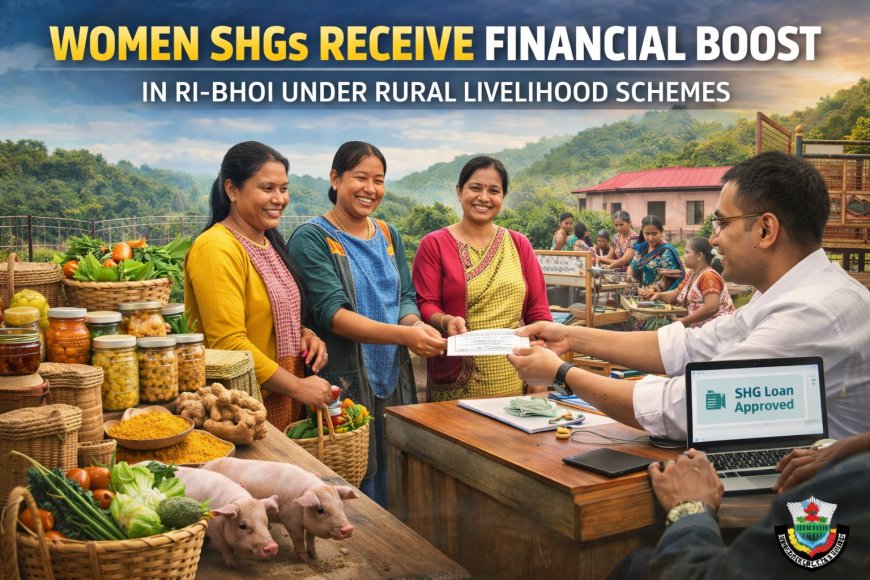
Ri-Bhoi, February 27, 2026: In a significant push toward grassroots entrepreneurship and women-led economic growth, hundreds of Self-Help Groups (SHGs) in Ri-Bhoi district have received fresh financial assistance under Meghalaya’s rural livelihood framework aligned with the National Rural Livelihoods Mission.
District officials said the move is aimed at strengthening micro-enterprises, enhancing financial inclusion, and building sustainable income models for rural women across blocks in the district.
The financial support includes revolving funds, community investment funds, and seed capital assistance designed to help SHGs expand their business activities and improve access to formal credit.
Strengthening Grassroots Entrepreneurship
At a district-level programme attended by rural development officials, banking representatives, and SHG members, authorities emphasized that the initiative is not just about distributing funds but about building long-term economic resilience.
“This assistance will enable women to scale up their enterprises, diversify livelihoods, and move towards structured entrepreneurship,” a senior district official said.
The support is expected to benefit SHGs engaged in activities such as:
- Organic farming and vegetable cultivation
- Ginger and areca nut processing
- Poultry and piggery units
- Handloom and handicrafts
- Food processing and packaging
- Small retail and service enterprises
Officials noted that groups with consistent savings discipline and strong repayment records were prioritized to encourage financial accountability.
Ri-Bhoi’s Strategic Economic Position
Ri-Bhoi district plays a crucial role in Meghalaya’s rural economy due to its proximity to Assam and access to larger markets like Guwahati. The district’s economic profile—rooted in agriculture, livestock, and small-scale trade—offers strong potential for SHG-based enterprise expansion.
However, women entrepreneurs often face challenges including limited access to credit, lack of business training, and market access barriers. The rural mission seeks to bridge these gaps through structured institutional support.
Under the SHG model, women pool savings, provide internal loans, and gradually build creditworthiness to access bank financing. Over time, many groups evolve into cluster-level federations capable of handling larger business volumes.
Focus on Financial Inclusion
Officials said the financial boost is part of a broader strategy to integrate rural women into formal banking systems. Training programmes on digital banking, bookkeeping, and enterprise management are being conducted alongside fund disbursement.
Bank representatives present at the event encouraged SHGs to adopt digital payment systems and maintain transparent financial records to improve credit access.
The initiative also aligns with the broader objectives of the National Rural Livelihoods Mission, which promotes women-centric community institutions as vehicles for poverty alleviation and economic empowerment.
Emerging Success Stories
Several SHGs in Ri-Bhoi have already demonstrated measurable success. Women’s collectives engaged in ginger processing have moved from selling raw produce to packaging value-added products, increasing profit margins. Livestock-based SHGs have pooled resources for feed procurement and veterinary care, reducing operational costs.
Handloom groups are reviving traditional designs while adapting to contemporary market trends, tapping into niche urban buyers.
Officials believe that with additional capital and proper market linkage, more SHGs can replicate these models.
Market Linkages and Scaling Up
A key focus of the initiative is connecting SHGs to larger markets. District authorities are working on facilitating participation in trade fairs, branding local products, and linking women entrepreneurs to institutional buyers.
Efforts are also underway to promote cluster-based production systems to improve economies of scale.
“Financial assistance alone is not enough. Market integration is essential for sustainability,” an official said.
Governance and Accountability
To ensure transparency, funds are being monitored through community-based audit systems and periodic reviews. Village Organizations and Cluster-Level Federations are tasked with overseeing fund utilization and compliance.
Officials indicated that impact assessments will evaluate income growth, enterprise sustainability, and repayment performance over the coming months.