

Youth Organizations Demand Inner Line Permit Expansion in Assam.
Proposal Sparks Fresh Debate Over Identity, Migration, and Economic Impact
 News Daily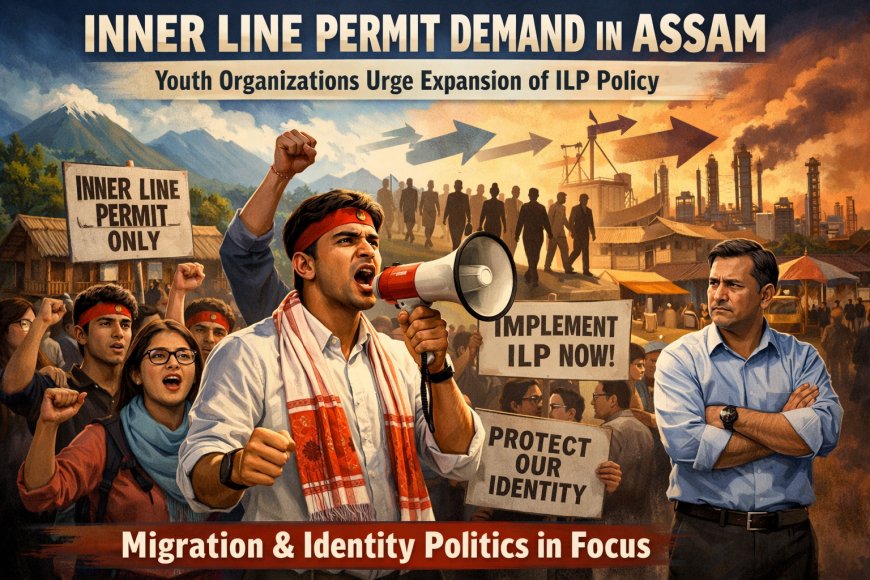
Guwahati, February 27, 2026:
The demand for extending the Inner Line Permit (ILP) system to Assam has gained renewed momentum, with several student bodies and youth organizations urging the state government to initiate steps toward its implementation. The proposal, modeled on ILP regulations currently operational in Arunachal Pradesh and Nagaland, has triggered widespread debate across political, business, and civil society circles.
Youth leaders argue that Assam requires stronger constitutional and administrative safeguards to address concerns over migration, land rights, and cultural preservation. However, industry stakeholders warn that such a move could impact trade, tourism, and investment in the state.
Memorandums Submitted to State Authorities
Student unions from Upper Assam, parts of Central Assam, and select districts in Barak Valley have submitted memorandums to district administrations and state officials, requesting a formal review of the ILP framework.
In their representation, youth organizations cited demographic changes, employment pressures, and long-standing identity concerns as reasons for introducing stricter entry regulations.
“We are not opposing development,” a student leader stated during a public discussion in Guwahati. “We are asking for protective mechanisms similar to other Northeastern states to ensure indigenous communities are safeguarded.”
What is the Inner Line Permit?
The Inner Line Permit system originates from the Bengal Eastern Frontier Regulation of 1873. It requires Indian citizens from outside designated states to obtain official permission before entering certain protected areas.
Currently, ILP is implemented in:
Arunachal Pradesh
Nagaland
Mizoram
Manipur
The mechanism aims to protect indigenous populations, regulate land ownership, and monitor migration.
Assam, despite being geographically and politically central to the Northeast, does not fall under the ILP regime.
Core Concerns Behind the Demand
Demographic Pressures
Youth bodies argue that Assam’s demographic profile has undergone significant changes over the decades due to migration from both neighboring states and across international borders. They contend that without institutional checks, indigenous communities may face long-term cultural and political marginalization.
Employment and Land Issues
Rising unemployment among educated youth has amplified demands for protective policies. Student leaders claim that competition for jobs and land ownership has intensified, particularly in urban centers and peri-urban districts.
Identity Safeguards
The debate has also been shaped by post-CAA concerns, where ILP states were granted certain exemptions. Activists argue that extending ILP to Assam could strengthen identity safeguards and reinforce local confidence in governance.
Government’s Cautious Response
The Government of Assam has not made any formal commitment regarding ILP expansion but has indicated that such a move would require careful study, legal consultation, and coordination with the Union government.
Sources within the administration suggest that constitutional implications, administrative feasibility, and economic impact assessments would be critical before any decision is taken.
Legal experts note that implementing ILP in Assam would involve central approval and possible notifications under existing regulatory frameworks.
Business Community Raises Concerns
Trade bodies and industrial associations have expressed reservations about the proposal.
Business leaders argue that Assam functions as the economic gateway to Northeast India, facilitating supply chains, logistics, and interstate commerce. Introducing permit requirements, they say, may increase compliance burdens and discourage outside investment.
The hospitality sector has also voiced concerns that tourism growth could be affected if additional entry formalities are introduced.
“Ease of doing business must remain a priority,” a representative from a Guwahati-based trade association said. “We need balanced solutions that protect identity without creating economic barriers.”
Comparison With Other Northeastern States
States like Arunachal Pradesh and Nagaland operate ILP within specific socio-political contexts, including constitutional protections under Article 371 provisions and strong customary land ownership systems.
Manipur was brought under ILP in 2019 following prolonged public agitation demanding protection of indigenous rights.
However, experts point out that Assam’s larger population, more diverse ethnic composition, and stronger industrial base present different administrative challenges.
Sixth Schedule and Overlapping Safeguards
Large parts of Assam already fall under Sixth Schedule autonomous councils, which provide protection to tribal communities in districts such as Bodoland, Karbi Anglong, and Dima Hasao.
Policy analysts argue that any ILP framework would need to align with these existing mechanisms to avoid jurisdictional overlap and administrative confusion.
Security and Border Dimensions
Assam shares international borders with Bangladesh and Bhutan. Migration from across the Bangladesh border has historically been a politically sensitive issue in the state.
Supporters of ILP expansion believe the system could serve as an additional monitoring tool for regulating inward movement. Critics counter that ILP primarily governs inter-state movement of Indian citizens and may not directly address international border concerns.
Public Opinion Divided
Public response to the ILP demand has been mixed. While many youth groups support stronger safeguards, sections of urban residents and entrepreneurs worry about the potential impact on mobility and commerce.
Social media platforms have seen active debate, with hashtags related to ILP trending locally.
Political observers note that identity and migration remain central themes in Assam’s electoral and policy discourse. The ILP issue may therefore gain further traction as consultations progress.
Possible Policy Pathways
Experts outline several options that the government could consider:
Conducting a detailed feasibility study on ILP implementation.
Introducing targeted land protection laws instead of full ILP coverage.
Strengthening digital registration systems to monitor migration.
Maintaining the status quo while tightening enforcement of existing safeguards.
Any decision, analysts say, will require balancing identity protection with economic openness.
The Road Ahead
The renewed ILP demand signals that migration and identity politics continue to shape Assam’s governance landscape. For youth organizations, the issue represents a call for constitutional safeguards and cultural preservation. For businesses and policymakers, it raises questions about economic sustainability and administrative practicality.
As consultations continue, the debate is likely to intensify across public forums, legislative discussions, and civil society platforms.
For now, the proposal remains under discussion, but its political and social significance ensures that the ILP debate will remain a central issue in Assam’s policy landscape in the months ahead.