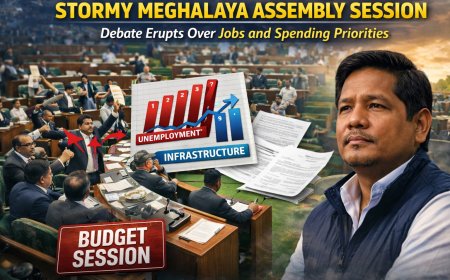

Stormy Scenes in Meghalaya Assembly as Budget Debate Sparks Uproar Over Jobs and Spending.
The heated debate inside the Meghalaya Legislative Assembly underscores the centrality of jobs and fiscal priorities in Meghalaya’s development agenda. With a young population and evolving economic landscape, policy choices made during this Budget Session will shape the state’s growth trajectory in the coming years.
 News Daily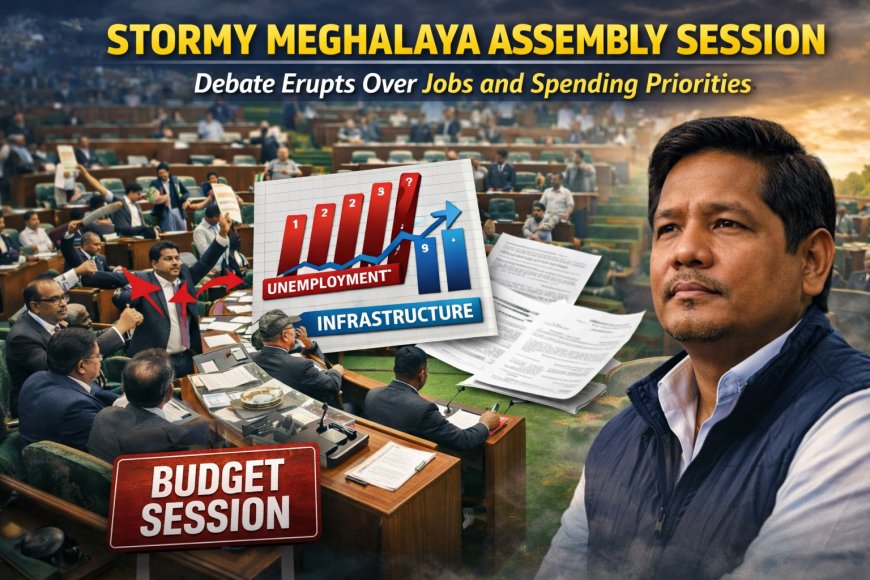
Shillong, February 27, 2026: The Budget Session of the Meghalaya Legislative Assembly witnessed intense exchanges on Friday as Opposition MLAs and treasury bench members clashed over unemployment data, infrastructure allocations, and fiscal transparency. The debate, marked by repeated interruptions and sharp remarks, has brought employment and development priorities back to the center of Meghalaya’s political discourse.
The flashpoint came during discussions on demands for grants related to labour, skill development, and public works departments, where Opposition legislators questioned the accuracy of job creation figures presented in the Budget.
Opposition Demands White Paper on Employment
Opposition members called for the government to table a comprehensive white paper detailing the exact number of jobs created over the past three years. They demanded clarity on department-wise vacancies, recruitment status, and measurable outcomes of skill development and entrepreneurship schemes.
Several MLAs alleged that the government’s employment numbers include short-term placements and training enrolments rather than sustainable, long-term jobs. They argued that unemployment remains a serious concern, particularly among educated youth in rural and semi-urban constituencies.
“Ground reality does not match the figures being presented in the House,” one Opposition legislator said during the debate, urging greater transparency.
In response, ministers defended the government’s track record, asserting that employment generation must be viewed holistically. They highlighted initiatives under rural livelihood missions, start-up promotion schemes, tourism expansion, and self-employment programs.
However, the government stopped short of committing to a formal white paper, stating that detailed data is available through departmental reports and can be discussed further during the session.
Infrastructure Allocations Under Lens
Apart from employment, infrastructure spending emerged as a key area of contention. The Budget proposes increased capital outlay for roads, urban development projects, power distribution upgrades, and rural connectivity improvements.
Opposition MLAs questioned the pace of project execution, citing delays in highway upgrades and cost overruns in certain public works initiatives. Concerns were also raised about whether infrastructure investments are evenly distributed across districts.
Legislators from interior constituencies argued that remote areas continue to suffer from poor road conditions and limited public facilities, while urban centers receive a disproportionate share of development funds.
The Finance Department maintained that capital expenditure has steadily increased in recent years and that infrastructure investments are essential for long-term economic growth and job creation.
Rising Youth Unemployment Remains Central Issue
The stormy exchanges reflect broader anxieties over youth unemployment in Meghalaya. With thousands of graduates entering the workforce annually, demand for stable employment opportunities has intensified.
Government jobs remain highly sought after, resulting in stiff competition for limited vacancies. While self-employment schemes and skill training programs have expanded, critics argue that they have yet to produce sufficient large-scale employment.
Student groups and youth organizations have been closely following the Assembly proceedings, with many voicing support for greater clarity on recruitment timelines and vacancy backlogs.
Fiscal Responsibility Debate
The debate also touched upon Meghalaya’s fiscal position. As a resource-constrained state with limited industrialization, Meghalaya relies heavily on central transfers and shared tax revenues.
Some MLAs expressed concern over rising debt levels and urged caution in expanding borrowing for infrastructure projects. They called for a stronger focus on revenue-generating sectors such as tourism, agro-processing, and digital services.
Treasury bench members countered that strategic borrowing for capital expenditure is necessary to stimulate economic activity and create multiplier effects.
Political Undertones
Observers note that the intensity of the debate reflects political positioning ahead of future electoral cycles. Employment and development remain decisive issues for voters across the state.
While the ruling coalition emphasized achievements in rural electrification, water supply, and road connectivity, the Opposition framed the discussion as a question of accountability and performance.
The exchanges at times forced temporary adjournments as members demanded clarifications and raised procedural objections.
Calls for Greater Transparency
Beyond employment figures, MLAs across party lines called for improved transparency in project monitoring and expenditure tracking. Suggestions included:
- Public dashboards for infrastructure progress
- Time-bound recruitment calendars
- Independent audits of flagship schemes
- Enhanced legislative oversight mechanisms
The government indicated that digitization efforts are underway to improve reporting systems and make departmental data more accessible.
Public Interest High
The Budget Session has drawn significant public attention, with debates widely discussed across local media and social platforms. Civil society groups have emphasized that employment and infrastructure are not abstract policy issues but matters directly affecting livelihoods and daily life.
Business associations have also urged the government to focus on ease of doing business reforms and private investment facilitation as part of a comprehensive employment strategy.
Government’s Closing Remarks
In concluding remarks for the day, government representatives reiterated their commitment to inclusive development. They outlined plans to:
- Expand tourism circuits
- Promote MSMEs and start-ups
- Strengthen skill development partnerships
- Accelerate rural infrastructure projects
Ministers emphasized that employment generation is a long-term structural challenge requiring sustained effort rather than short-term measures.